Concrete retaining walls in Carlsbad CA - built to hold back the slope and drain
Soil slumping onto your yard or an old wall leaning out? We build concrete walls planned around the slope, the load and the water behind them.
- Licensed and fully insured.
- Free estimates at your property.
- We reply within 1 business day.
What goes into building a concrete retaining wall in Carlsbad?
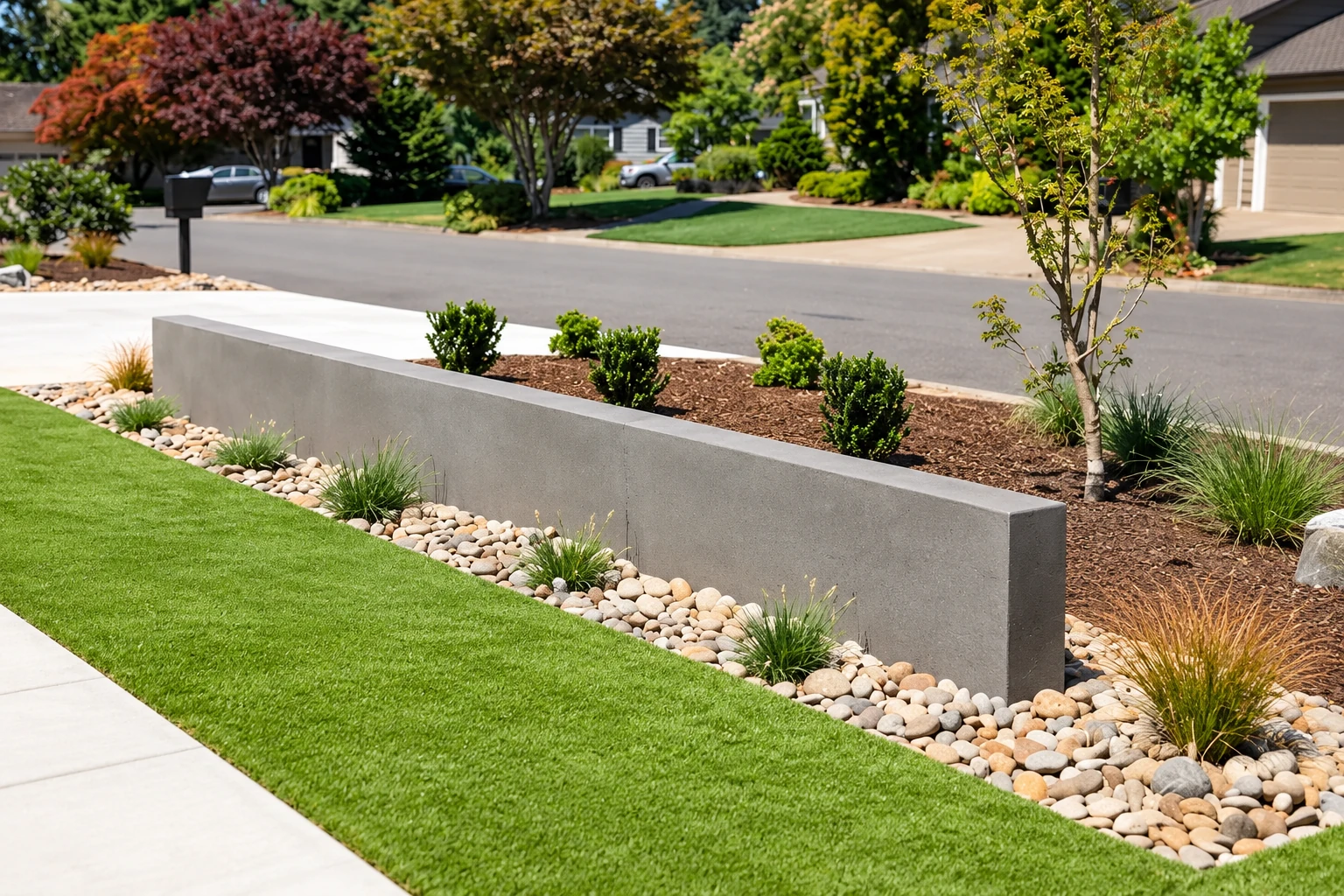
A concrete retaining wall in Carlsbad is a poured wall with steel inside, a fairly thin upright stem standing on a wide base slab, built to hold back the sideways push of the soil behind it so a slope stays put and you get usable flat ground.
Most people call when a bank keeps creeping onto the yard, an old wall has started to lean, or they want level ground for a patio or a play area. The price moves with the wall's height and length, what it has to hold up, like a steep bank, a driveway or a building near the top, how much drainage goes behind it, how easy it is to get a crew and a concrete truck to the spot, and whether an old wall comes out first. The schedule turns mostly on the permit and its inspections, which we handle, and on giving the concrete time to gain strength before any dirt goes back against it. Your written estimate spells out what's covered for your wall.
How do you know if a slope or an old wall needs work?
Wall leaning out at the top
If the top of a wall sits farther out than the bottom, the soil behind it is winning, usually because water has built up back there or the footing wasn't sized for the load. A lean only grows, and a wall that tips the rest of the way takes the yard and whatever sits on it along with it.
Water seeping through the face
Wet patches, white chalky streaks or a trickle coming out of cracks mean water is trapped behind the wall with no clear way out. That water pushes on the wall every time it rains, so the longer it goes, the more you end up paying to undo.
Soil slumping onto the yard
A bank with no wall, or a wall too short for it, sheds dirt onto patios, paths and planters after every storm. Each slide undercuts the slope a little more, and soil creeping toward a fence, a slab or the house is a bigger fix than holding it back now.
How we build concrete retaining walls
A wall holding back dirt is a structure, so before we talk about height I look at what's around it, the slope above, a driveway where cars park, a house or garage near the top, water in the ground and any soil that might settle, because height alone doesn't tell you how strong the wall has to be. Then our crew digs out and forms the footing and base slab, sets the rebar, the steel that keeps the wall from bending under the soil's push, and pours the stem in place. Behind it we lay drainage gravel, filter fabric and perforated drain pipe with outlets that let the water out, and that drainage is written into our quote as its own line, not left as an extra. I learned in kitchens that a bad night starts during prep, and a wall is the same, so most of our time goes into the footing and the drain you won't see once the dirt is back.
A wall usually makes room for something, and the flat ground it creates is often where the next pour goes. We build concrete pool decks on terraces a wall has opened up, and handle concrete floor installation for a workshop or storage room on the new level, so the wall and the slab beside it get planned together.
Plain formed face
This suits most walls holding back a yard slope or a driveway cut, because the money goes into the footing, steel and drainage that do the holding. If the budget's tight, this is where I'd keep it, since a nice face on a wall that pushes over buys you nothing.
Textured or decorative face
This suits a wall that faces the patio or the street, where you'll look at it every day. We add it on top of a sound wall, never in place of the parts that keep it standing.
Get a written estimate for your retaining wall
Send the form and we'll reply within 1 business day to set up a visit. I'll come look at the slope myself, and the estimate is free, done at your property, obligation-free and written out line by line.
Call (760) 579-6596- Based in
- Carlsbad, CA 92008
- Hours
- Mon–Sun: 7 AM–10 PM
What happens when you call about a retaining wall in Carlsbad?
Here's how a retaining wall job runs from your first call to the final walk-through, and who you'll be dealing with at each step.
Call or send us a message
Call or use the form, and we'll set up a time for me to come out. If an old wall is there now, mention it, since taking it out becomes part of the job.
I walk the site with you
I look at the slope, what sits above and below the wall, and where the water goes when it rains, then hear what you want the ground to do for you. Ask me anything while I'm there, because every question is a fair one.
You get a written estimate
The estimate lists what's in and what's out, with the footing, steel, drainage and any extras like removing an old wall each on its own line. That way you can hold it next to another quote and see whether the drainage is actually there.
We build it and walk it
Once you say go, we line up the permit and inspections, prep the site, pour when everything's ready and fill behind the wall once it's strong enough. Then we walk the finished wall with you so you know how to look after it.
Why Carlsbad homeowners call Form & Pour for retaining walls
I come out and run the pour
I look at the job and write the estimate myself, and our own crew does the forming, pouring and finishing with me running the pour. The person who measured your slope is the one standing there when the concrete goes in.
Building on sloped lots since 2017
We've been in business since 2017, nine years of forming and pouring on hillside and graded lots across San Diego County. That's long enough to have seen what a skipped drain or a loose form does to a wall a few rainy seasons later.
Licensed and fully insured crew
We're licensed and fully insured, and the state licensing board describes concrete contracting as forming, pouring, placing, finishing and installing concrete, which is the work we keep in our own hands. You aren't hiring someone who passes your wall along to another crew.
On a retaining wall, the part that matters most ends up buried, so ask for a site visit and I'll show you exactly what goes behind yours.
Retaining walls, permits and slopes in Carlsbad
The City of Carlsbad says most construction work needs a permit, and building permits are generally required when you add a new structure, so for a new retaining wall we plan on one and confirm the details for your lot with the city's building permit office. Once a permit is issued, the city has to inspect the work and the permit holder schedules those visits, so we handle the paperwork, book the inspections and tell you up front what we'll need from you. About 37% of Carlsbad sits in the coastal zone, where the city sets its own development standards and most projects need the appropriate coastal permits, so if you're near the water, that's one of the first things we look up.
A lot of the walls we build here hold back cut banks behind houses and slopes above driveways, and we see the same kind of ground on jobs in Oceanside and San Marcos. If your lot falls in one of the state's landslide hazard zones, which usually mark steep hillsides of weak ground that can give way in an earthquake, bring it up at the estimate, because shaking is one of the loads a wall has to be planned for.
Questions about retaining walls in Carlsbad
Call (760) 579-6596How much does a concrete retaining wall cost in Carlsbad?
A poured concrete retaining wall about 3 feet high usually costs about $46 to $50 per square foot in Carlsbad, with labor and materials included. That's the area's usual price, not our quote, and the written estimate from your site visit gives you the figure for your wall.
What does a typical retaining wall price not include?
The usual per-square-foot price leaves out tearing out an old wall, terraced walls, decorative finishes, extra height and curved designs. If any of those are part of your plan, ask for each one as its own line so you can see what it adds.
Why does a retaining wall need drainage behind it?
Water trapped in the soil behind a wall can greatly increase the load on it and work its way through as leaks. Giving that water a way out, and keeping surface water from running over the top, takes that extra push off the wall.
When can soil be backfilled behind a new concrete retaining wall?
Only once the concrete has gained enough strength to take the push of the soil, not the day after the pour. Then the dirt goes back in controlled layers, each one compacted with equipment that won't shove the new wall out of line.
What is the best way to choose between a concrete and a block retaining wall?
Start with the ground, because highway design guidance rates poured cantilever walls among the least tolerant of settling soil. The block industry's own guide says block units can move and adjust without showing distress while rigid walls may crack, so on ground that might settle I'll talk through both with you before you choose concrete.
How do I take care of a concrete retaining wall?
Keep the drain outlets at the base clear and working so water keeps leaving the soil behind the wall. Pull leaves and dirt out of them after storms, and if one stops running, call us before the water builds up.
Related services for the ground around your wall
Concrete floor installation
If the new wall opens up level ground for a workshop, studio or storage room, a properly prepped floor slab turns that space into something you can use.
Concrete pool decks
Many walls go in to carve out room near a pool, and a deck poured on well-packed ground gives you a flat, drained surface around the water.
Service areas for our retaining wall work
Form & Pour Carlsbad Concrete Company is based in Carlsbad, CA, and builds retaining walls in the 12 cities listed here, including Vista and Encinitas. We work in plenty of cities beyond these pages too, so ask even if yours isn't listed.
Carlsbad, CA
Tell us about the slope you need held
Call (760) 579-6596 or send the form with the wall's rough height and length and what sits near it, like a slope, a driveway or a building, so the first visit starts with the right questions.